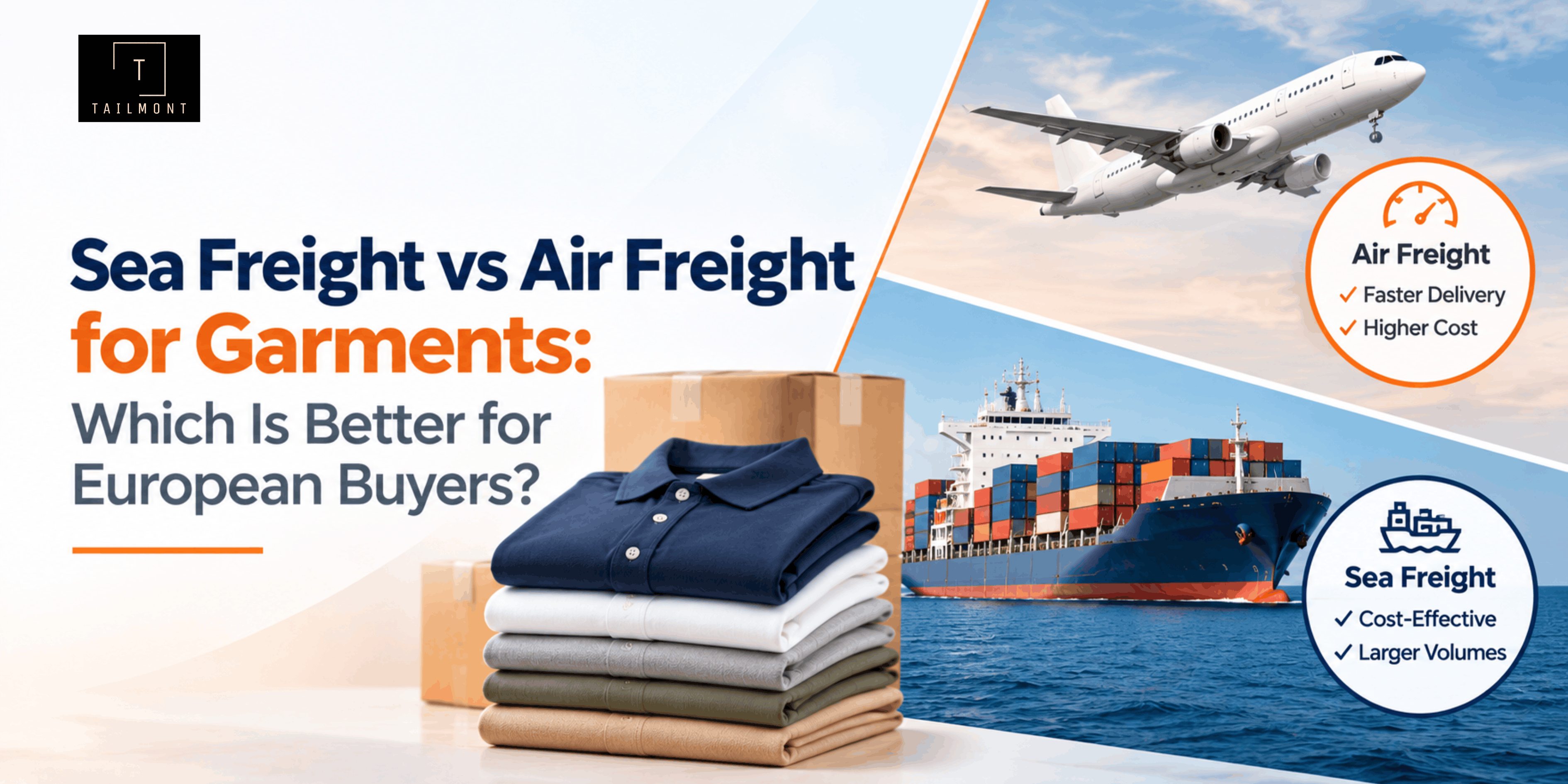
Sea Freight vs Air Freight for Garments: Which Is Better for European Buyers?
Your bulk order is ready, but the shipping decision can make or break the margin. For Dutch and European importers, sea freight vs air freight for garments is a question of cost, speed and risk, not just price per kilo. Choose sea and you may miss the season; choose air and you may lose profit. This guide breaks down both options, shows when each one wins, and helps European buyers plan every garment export shipment with far fewer costly surprises.
Garment Export Shipping: The Two Main Options
Most apparel orders from India to the Netherlands and wider Europe travel by sea or by air. Small samples usually go by courier. Each mode suits a different kind of order, and the right choice depends on your delivery date, order value and product type.
Sea Freight vs Air Freight for Garments: Quick Comparison
|
Factor |
Sea Freight |
Air Freight |
|
Cost per kg |
Lower |
Higher |
|
Transit time |
Several weeks |
A few days |
|
Best for |
Bulk, planned, core ranges |
Urgent, small, high-value orders |
|
Volume |
Large shipments (container loads) |
Small to medium shipments |
|
Carbon footprint |
Lower |
Higher |
|
Planning needed |
Early |
Flexible |
General market positioning. Always confirm with current freight quotes.
Sea Freight for Garments: Where It Wins
Sea freight is the default for bulk apparel because it keeps the cost per piece low.
- Best value on volume: ideal for core ranges, basics and private label programmes.
- Lower emissions: useful if your brand reports on sustainability.
- Flexible loading: full container or shared container options exist for different order sizes.
The trade-off is time and care. Cartons need proper packing and moisture protection, and your production calendar must leave room for transit and customs.
Air Freight for Garments: When Speed Matters
Air freight earns its higher price when time is the real constraint.
- Urgent replenishment: restock best-sellers before a gap appears.
- Fashion drops and launches: hit a fixed date without delay.
- Rescue shipments: recover from a late production or a missed sailing.
The downside is cost. On low-priced items such as basic tees or polos, high freight can wipe out the margin.
Transit Time, Cost and Risk Compared
Transit Time and Season Planning
Sea freight vs air freight for garments mainly comes down to the calendar. Sea shipments from India to North European ports typically take several weeks port to port, depending on route and disruptions, while air takes only days. Add production, inland transport and customs clearance on both sides, and plan backwards from your in-store date.
Cost: Sea Freight vs Air Freight for Garments
Air freight is often several times more expensive per kilo than sea. Compare landed cost per piece, not just the freight invoice. Include freight, insurance, duties, handling and any storage costs.
Your trade terms matter too. Under FOB, you arrange and pay for main freight from the port of origin. Under CIF, the supplier arranges freight and insurance to your destination port. Choose the term that matches your experience and control needs.
Risk, Packing and Customs
Longer sea journeys increase exposure to delays and humidity, so garments should be packed in sealed poly bags inside strong cartons. Prepare clean customs documents, including the commercial invoice, packing list and correct product classification, and check current EU duty and VAT before you order.
How to Choose the Right Shipping Mode
- Choose sea when the order is large, the delivery date is flexible and margin matters most.
- Choose air when the order is urgent, small or high in value per piece.
- Choose courier for samples and pre-production approvals.
Use this rule of thumb when comparing sea freight vs air freight for garments: divide total landed cost by the number of pieces and test it against your selling price. If air freight still leaves a healthy margin, speed may be worth it. If not, plan earlier and ship by sea.
A Smart Hybrid Strategy for Importers
Many buyers do not pick just one. They ship the main volume by sea and keep a small air shipment ready for fast sellers. Treating sea freight vs air freight for garments as a split decision, rather than an either-or choice, protects both margin and availability.
Why Choose TailMont
- Premium quality you can trust: carefully selected fabrics, skilled workmanship and rigorous quality checks.
- Customisation that fits your brand: fabrics, colours, fits, labels, trims, printing and embroidery.
- Consistent, reliable supply: dependable production and timely deliveries that help you plan inventory.
- Export-ready support: TailMont supports B2B apparel manufacturing, customisation and export-related enquiries for the UK, the Netherlands and Europe.
- Timeless designs: clean, modern styles that stay relevant beyond seasonal trends.
- Customer-first approach: responsive support and transparent communication at every stage.
FAQs
Which is better: sea freight vs air freight for garments?
Neither wins every time. Sea suits bulk and planned orders, while air suits urgent or high-value orders. Compare landed cost per piece against your delivery date.
How long does sea freight take from India to the Netherlands?
Typically several weeks port to port, but timing changes with route, port congestion and disruptions. Confirm the current schedule with your freight forwarder.
Is air freight worth it for garment samples?
Yes. Samples are small and time-sensitive, so courier or air is usually the practical choice.
What is the difference between FOB and CIF?
Under FOB, the buyer arranges main freight from the origin port. Under CIF, the seller arranges freight and insurance to the destination port.
Ready to Plan Your Next Apparel Order?
Share your styles, quantities and target delivery date, and our team will guide you through the next steps.
Request a Quote | Polo T-Shirts | Casual Shirts
Email: info@tailmont.com | Phone: +91 8971529797
Follow TailMont:
- LinkedIn: https://www.linkedin.com/company/tailmont
- Instagram: https://www.instagram.com/tailmont.official/